
China is still in a holding Pattern when it comes to pine import prices with low demand generally during July with Log Prices CIF China sitting still at the 110.00 USD recovering slightly from June low of Just over 102.00 CIF USD per Jas M3 at the very bottom. Right now, any price indicators moving upwards looks well and truly set to stay there for sometime to come as Log Stocks on China Wharfs are still high with indicators there is 4-4.7 Million ton on combined wharfs.
The other Key factors in the market is the trade war continuing between China and the USA with Donald Trump Threatening further tariffs in Early 2020
The contributing factor is China moving its USD Value on the RMD to try and aid China Exports against US Tariffs on goods, Don’t forget All imports into china are conducted In USD this means this also contributes to imported products into china costing more which in effect directly effects the log export prices and volumes out of NZ to China.
Currently reported by other media there is some 70 Crews now parked up since the beginning of June in the mid to upper north Island.
In moving forward in this market if the indicators are correct and the prices remain circa the 110 CIF USD may be something, we have to get used to in the interim however the previous Regime of prices over 140 USD was unsustainable with many forest blocks being harvested prematurely. Even though we don’t like it it might be time to look at the baked bean tins for a while and forget about the caviar.
Moving forward I think over the next 12 months prices will move slowly back up as the log market recovers slightly and the subsidy on the train routs into Russia are withdrawn which is indicated to be somewhere around March 2020.
The commodities business in general is supply-demand based whether that be apples and oranges or Pine Logs, As we see the stocks on the Wharfs in china reduce due to the fact that the ships have stopped to transport product and the harvesters have stopped harvesting logs prices will inevitably come back to something more realistic for both the Chinese importer and the NZ Exporter. In essence the market requires stability and sustainability long term.
The solution in this market relies on China and USA coming to an agreement which in turn ill reduce currency pressure in the market and remove the instability currently in play.
China Manufacturing and Purchasing Index (shown below ) tells its own story.
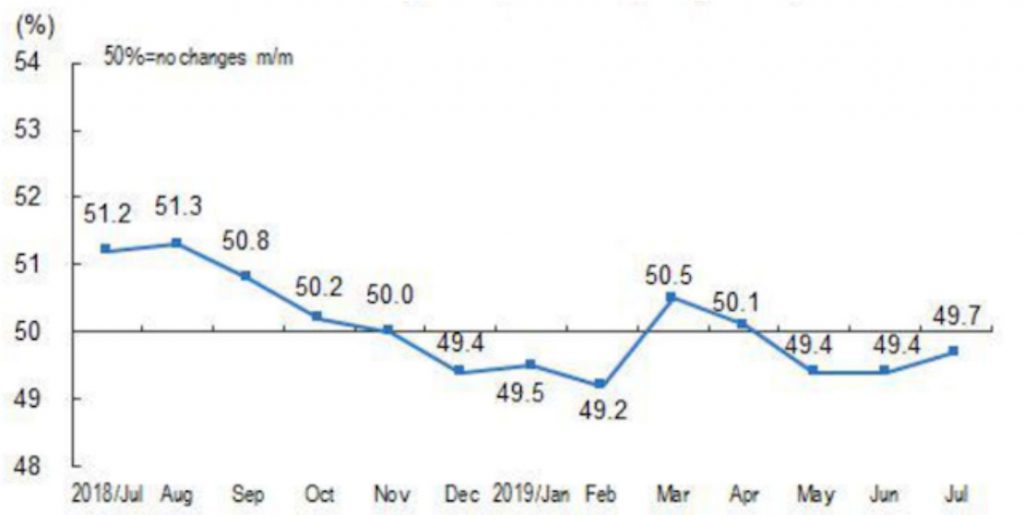
China: Manufacturing Purchasing Managers Index – In July 2019, China’s manufacturing purchasing managers index (PMI) was 49.7 percent, up 0.3 percent point from the previous month, indicating that the prosperity level of manufacturing industry has rebounded.
Q2 China log import prices
For the April – June quarter log import prices into China decreased 12.2 percent y-o-y to US$ 169 per m3. Volumes were steady during the quarter, down just 0.63 percent to 16 million m3 according to China Customs data.
New Zealand Commodities Price Index
New Zealand commodity prices fell in July, weighed by the recent fall in forestry and dairy prices.
The ANZ world commodity price index fell 1.4 percent in July after falling 3.9 percent in June. The July index was 0.5 percent lower than it was a year ago. In local currency terms, the July index fell 2.8 percent but was up 0.3 percent on the year.
The forestry price index fell 8 percent as demand from China for logs fell away, A high level of supply of logs from New Zealand and other regions has resulted in a build-up of stock on wharves in China, at a time when usage rates have eased.
Building activity slows in China during its hot summer months and buyers are also more cautious than normal due to the impact the trade war between China and the United States is having on manufacturing activity
Dairy prices fell 1.6 percent in July, but are now starting to firm, Butter and cheese prices remain under some pressure, particularly in Europe. New Zealand skim milk powder has been trading at a premium to product from other sources. Whole milk powder prices are stable and are expected to be supported in the year ahead by relatively tight supply.
The meat and fibre index lifted 1.6 percent in July following a similar lift the previous month. Higher international prices were recorded for both beef and lamb, with strong demand from China the driving factor.
The horticulture index inched up 0.2 percent in July and aluminium prices lifted 2.4 percent in July, to record the first positive price movement since March. Prices are still 13.1 percent behind levels one year ago showing a generalisation to a slowing Word Economy.
All in all not a rosy picture for the immediate future as we batten down the hatches for 2020.
Brian Mahoney
NZ Forest Products Group Limited
